March 6, 2014

Laughing With Those Who Laugh

His name is Thibodeaux*, and he spends most of his weekdays with us at the Free Market, enjoying the simple pleasures of a couch, a cup of coffee, and sometimes conversation. But more often than not, what comes out of his mouth is not conversation, but a laugh. He doesn't tell jokes and doesn't hear many of them, at least not that we see around here, but he laughs anyway. In the middle of silence or while people are talking, he bursts out for just a moment with a smile and and a laugh that he can't suppress. If there is something in particular that he is laughing at, it's a secret. God only knows what sense this makes, because it's never been clear to me.

Thibodeaux has watched us go through some changes over the last few weeks. Going forward, we are operating the Free Market from the back alley door of the hub. It took all of our team a couple days to reverse our whole operation so that what was our back alley exit is now our front door. We have had to change how we do some of what we offer, and in some cases we have had to stop offering certain services altogether. It's a far from ideal situation, and to be honest it has hurt to hear ourselves telling our guests to come in through the back door. A few folks have let us know how it feels to be told to use the back door, and it isn't exactly dignifying. We've also heard encouragement and gratitude from our guests as they realize the situation and bear the changes with us.

The reasons for the changes have to do with the effect of our presence in Ybor City. As we have grown in how many people we serve, Ybor has not appreciated the visibility of homeless people centered around our block, both during and outside of our hours of operation. The increase in trash, urinating, and defecation hasn't helped either, but the biggest issue is visibility, hanging out, and sleeping in front of the hub and other buildings on 7th Avenue, the front door of Ybor City. As our work of hospitality makes our block less hospitably to business, we are wearing out our welcome.

So we find ourselves in the strange position of asking our guests not to hang out in front of the building, or any other building on our block, to help keep us from getting shut down altogether. We ask them to go away because they're homeless and needy, and because we know that the world at large does not take kindly to their presence. What's weird is that this is also why we welcome them to come inside and make themselves at home. Our reason for welcoming our guests into this makeshift home of ours also means that we have to shoo them away from anywhere just outside our walls.

I'm sure it's all reasonable and understandable, at least until you're the one who gets to go tell everyone to disappear, and then hours later welcome them as you would welcome Christ, and then a few hours later, get rid of them again. It reminds me of a bar closing, when they shout out, "You don't have to go home, but you can't stay here!" It's a good way to get rid of people at the end of the night, but it's not good enough when the people have no home to go home to.

God only knows what sense this makes, because it's never been clear to me. And it's made me mad. Sometimes I get mad at the city for caring about the unsightliness of people without caring about the people themselves. Sometimes I get mad at our guests for not trying harder or being more considerate. But this morning, when Thibodeaux caught me off guard with a sudden laugh, I found myself smiling and letting out an honest chuckle, even if I tried to hide it. Because right now, when I most want to lash out in anger or in tears, the most sane thing to do may just be to laugh instead. Thibodeaux knew it all along, that laughing is sometimes better than crying, so we just laugh...and then carry on.


If we do not laugh at ourselves, and allow others to laugh at and with us, we tend to worship ourselves. At times we all take ourselves too seriously, forgetting to laugh at the mirror and refusing to let others see us as we are, as little children toddling toward the Kingdom.
-David Athey


*His name is not Thibodeaux. He might not even really be a "he". But if you're going to use a pseudonym, you might as well make it an interesting one. Thibodeaux. Yeah...

February 7, 2014

Outside Our Window


The location of the Well's Free Market is in the heart of Ybor on 7th Ave. We are situated across the street from a pretty hip little skate shop owned and operated by a local skate park. They are wonderful neighbors and have even made a few donations to the Free Market at times. 

Late morning yesterday we started noticing folks setting up lawn chairs in front of the store and wondered about what was going on there. A little latter I noticed that a few of those seats were being occupied by some of our guests that we know, and who live on the streets. One of them yelled for me and ran across the street to ask me a question and I in turn asked him what was going on over there. He said "oh some new shoe is coming out on Saturday morning and some of the kids are paying us to sit there and hold their spots." "Shoes?!" I asked in disbelief. "I know" he said "but at least its an opportunity to make a few bucks."

They stayed there through the night in those chairs and this morning when we opened up the Free Market we had person after person come in for coffee and then leave to go sit in one of the chairs. At one point, when there was a particularly large crowd here, I asked what would happen if we decided to set chairs out on 7th on any other night and sleep there for a few days. They all laughed and insisted that wouldn't fly for a single night. They are right, it wouldn't fly. It seems strange to me that this same behavior is just fine if you are there to make a purchase, even if it means you camp out on 7th for two straight nights. Even if you pay homeless people to camp out there for you. Those same people who would get run off in a heart beat are just fine if they are on behalf of someone trying to come up on some new Nikes. 

Many of our guests have gladly taken the 'job' of place holder. They are getting paid anywhere from $20 bucks (at the lowest that I've heard) to about $50 (was the highest I heard of) to sit out front of this store for two straight nights so their teenage employers can drop a few hundred dollars on a pair of shoes. Meanwhile those same guests keep stopping in asking if we have any shoes to share with them. Any shoes would be appreciated. 

I know this is not some huge injustice but it is still hard for me to look at. It breaks my heart to see this microcosmic expression of the gross inequality and materialism of our culture. The poor are underpaid and used as the rich waste and indulge without concern for their 'employees' who have so little. The police turn a blind eye to the same behavior the poor are punished for if it is done in the name of capitalism and commerce. This is the situation outside our window today and it is a vignette of the reality outside your windows everyday. 


January 31, 2014

There Goes the Neighborhood: Justice Amid Gentrification


This post is the fifth & final post in a series examining how city development impacts the poor. If you haven't read the first, second , third & forth posts, start there as it will help make sense of what follows.


The groundbreaking that took place last Wednesday morning on the corner of 13th and East Juneau in Sulphur Springs was the event that sparked this series. My hope has been to help us pull back from the particulars and gain some perspective by looking at the general trends within which this instance is embedded. It is this larger picture that allows us to hear the words spoken there clearly in the light of history, our trajectory, and our habit of displacing the poor. I personally can’t help but question the end towards which we are striving as I hear our mayor say “It's the beginning of the renaissance of Sulphur Springs. We're committed all the way to the end.”


Here is the thing: Like it or not, the process of gentrification is happening. As Bob Lupton put it:
Resisting gentrification is like trying to hold back the rising ocean tide. It is surely coming, relentlessly, with power and growing momentum. Young professionals as well as empty nesters are flooding into our cities, buying up lofts and condos and dilapidated historic residences, opening avant-garde artist studios and gourmet eateries. If market forces alone are allowed to rule the day, the poor will be gradually, silently displaced, for the market has no conscience.
We can rail against it all we want, but the truth is that there is no stopping this reality. Before there is a complete demographic inversion, we will see — and are seeing — an ethnic and economic diversity in our communities like there has never been before in our city. Our work during this period is justice and reconciliation, and our demand will have to be gentrification with justice. We must have the conscience that the market will never have. We do not want to see the potential role reversal that will leave the poor on the (quite literal) margins of our city without access to basic services or necessary transportation to sustain themselves. The urban sprawl in Tampa will mean destitution for those without the means to get around, and this is only one reason why building solid public transit in our cities must be a priority. Gentrification with justice — as our cities and suburbs are diversifying we must help to fight for everyone to have a seat at the table and a voice in the development of their communities. As I heard Mayor Buckhorn say at the West Tampa Invision meeting on Wednesday "If you don't have a seat at the table, you are lunch." He did promise that North Boulevard residents would have a seat at the decision making table for the development in their community. It is encouraging to hear and justice would demand follow-through. So we hope, remember, keep paying attention, and demand accountability. 

There has never been a better time to seek reconciliation, justice, and a diversity equilibrium in our city, neighborhoods, churches and even our households. Our affordable public housing is (and should be) moving toward mixed income models, but we need to see far more of them in our city to begin approaching the real need. There is a great amount of work to do, and it is up to all of us if the tides are going to turn. New $100,000 homes being built in Sulphur Springs do not have to spell the beginning of the end for most of the current residents, but it will unless we all realize they too must have a seat at the decision-making table. Remember the poor; they are our neighbors, they are struggling, and they are human beings that are affected by such development and they matter.

We hope this series has been thought provoking and invite you to continue to pay attention and take part in what is happening around your own community. Go to neighborhood meetings, talk to your neighbors,  keep up with things like Invision Tampa, engage civic leaders, and for God's sake, remember the poor

January 30, 2014

There Goes the Neighborhood: (How) Marginalization Happens

This post is the forth in a series examining how city development impacts the poor. If you haven't read the firstsecond & third posts, start there as it will help make sense of what follows.


Image selected by David Smith & he wants you to know it!
Inner City has been a term used for some time that carries with it implications concerning poor, usually black and brown communities. As inner city neighborhoods are invested in, police are often utilized to clean up the area, and code enforcement comes along to lean on the homes of the poor that are poorly kept. I have known many neighbors who have been too old or disabled to do the work required by code enforcement, and equally too poor to pay someone, only to have liens put on their homes as the city fines them. Another issue is one of property tax: If you are poor and live in a house that your family has owned for generations, these taxes become the main financial burden of the house. As new neighbors invest in their own home and increase the value of the area, your property taxes rise as well. When left unpaid, investors will swoop in and pay your taxes so as to place a lien on your property and gain leverage for the impending exodus from your family home. God forbid you are just a renter in one of these neighborhoods where a landlord (who has always been trying to make some money on the property) realizes that they can do much better than you in terms of tenants and rent. Out you go as hip young suburbanites move into your old place.

As this slow tide of displacement transitions entire neighborhoods through complete demographic inversion, the older suburbs have become poorer, blacker, browner, and completely abandoned by the white folks with the money to move on. Temple Terrace has seen an 18% drop in median income, and the Greater Carrolwood area has decreased by 17%. While money continues to leave these areas and find itself in the urban center, it seems many of these suburbs have seen tremendous growth in Asian and Latino populations. If you have not noticed this as a Tampa resident, just take a drive down Waters Avenue from Florida Avenue to the Veterans Expressway, and pay attention to the shops and restaurants. Ask yourself who might run them. Stop and have yourself some Pho or Puerco Asado along the way. You’ll be glad you did.

Inner city, as the term has been used, is gradually becoming outdated.

So, The question remains: Where are the poor to go? For now it seems that the answer is Suitcase City, which has seen a 53% decrease in median income over the last few decades (as well as the surrounding neighborhoods). The poor, who have always been marginalized in our society, are now being pushed to the literal margins of the city itself. This is the trajectory of our city. It is also a damned shame.

It seems clear to me that our nation, our state, our city, our neighborhoods, and each of our streets can — and should — be judged by how we treat the poor among us. It is often by indirect effects (or indifference and neglect) that the poor are pushed around and into the margins. I am not bold enough to claim some grand design or conspiracy behind the poor emanating to the shorelines of despair in our city, but I do feel very comfortable pointing out the fact that we have not considered them. We have not included them in planning, and we have repressed every voice that arises on their behalf. They are bad for business.

Continue to part five: Justice Amid Gentrification

January 29, 2014

There Goes the Neighborhood: Demographic Inversion

This post is the third in a series examining how city development impacts the poor. If you haven't read the first & second posts, start there as it will help make sense of what follows.


Graphic artist Archie Archambault of Portland, Oregon has made a series of neighborhood-oriented maps for his hometown as well as Boston, San Francisco, and many other cities. It's a great way to get a feel for a city based on how people congregate into communities. He has not yet made a map of Tampa, so I mimicked his style to make the map shown here. It integrates a few of the areas conceptualized by Invision Tampa as well as other neighborhoods throughout the area. Numbers from the US census Bureau (adjusted to current dollar values) shows the median income changes in each area over a 22 year period from 1990 to 2012 demonstrating our past trajectory which helps in anticipating where we are going as a city. What I found is fascinating and may help inform current news such as The Nehemiah Project in Sulphur Springs.

Historic Ybor for example has seen a 130% increase in median income over that period of time as it rose from $13,000 in 1990 (adjusted to current dollar amount by census) to $30,000 in 2012. Downtown residents have seen a 143% increase in median income, VM Ybor increased 20%, while Ybor Heights — just to the north — only inched 5% upward over the 22 year period. Seminole Heights increased by 33%, and College Hill shot up by 109%. In fact, every community on this map that is inside (or rather, east and south of) the Hillsborough River saw a rise in their median income. Either those who lived in these communities have done extremely well for themselves, or the demographics of those communities have been in flux over a period of time. College Hill is an obvious example of a demographic transition taking place, as the public housing projects were demolished and replaced by a mixed income model which is now known as Belmont Heights. While many struggling families receive assistance to live in that community, many who lived there before have been displaced to areas like Sulphur Springs and Suitcase City.

Now the numbers for the communities on the other side of the river are quite different. Those old, early Tampa suburbs like Sulphur Springs, Egypt Lake, and Lowry Park Central have seen substantial decline in median incomes within their areas over the same period of time. While Egypt Lake dropped 22%, Lowry Park decreased by 28%, and Sulphur Springs saw a 31% drop — and as of 2012 had a median income of $20,000. These trends have continued, and today Sulphur Springs is a notoriously distressed neighborhood with all of the struggles and crime that have always accompanied poor neighborhoods. This is what the effects of gentrification are; just like the city spread in ripples like the pond's surface, so too the poor are now being displaced in the same way.

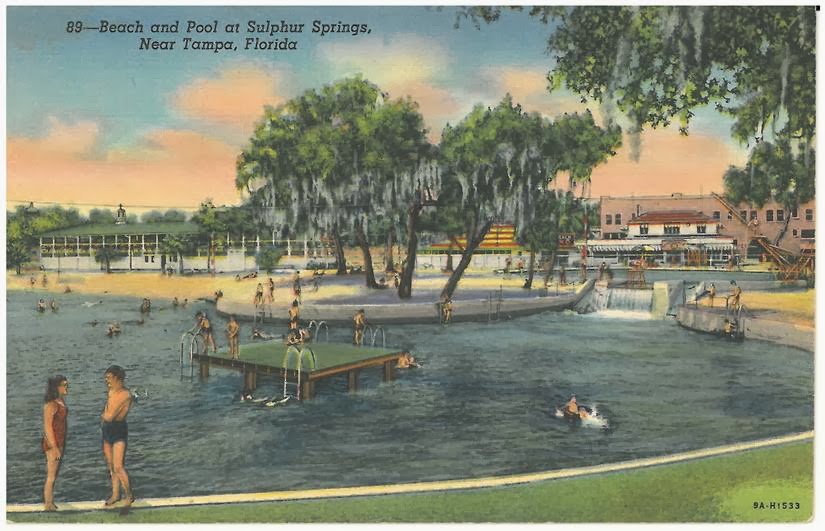
Beach and Pool Sulphur Springs Postcard
Beach & Pool at Sulphur Springs historic postcard.
All of those neighborhoods along the North & West side of the river are examples of some of Tampa's earliest and nicest suburbs when they were developed. They are all now the 'old burbs' as I labeled much of Egypt Lake and surrounding communities on the map. The houses are old and well worn, the neighborhoods are predominantly brown and black, and the housing and rent costs are relatively low. Sulphur Springs, the neighborhood which inspired this series, was a prize of Tampa and used to be the northern most destination of the old streetcar line. One will still find there the icons of its heyday such as the beautiful Springs Theatre, the old swimming pool (which used to be fed directly from the river), and the famous water tower that stands as a kind of flag to passers-by on the interstate. Old postcards found here reveal a Sulphur Springs that was "the most wonderful place you ever was at." As the website states:
 "What the postcards do not show is that Sulphur Springs, like all of Florida, was as a strictly segregated community, with most African-Americans living in the area known as Spring Hill. While white residents swam in the pool, African-Americans had to use other spots on the river for recreation, swimming, fishing, and baptisms. Many African-Americans traveled by bus to work as maids or golf caddies in Temple Terrace, a river community where the idyllic river postcards reflect a largely white reality."
Tampa is not as strictly segregated as it once was though it does retain a strong legacy as a community loosely segregated along some ethnic, though mostly economic lines. Sulphur Springs is today a  poor community with a population that is just over 6,000 people, and 47% of that population is below the poverty line, 36% are experiencing food insecurity and 19% of the current residents are unemployed according to Feeding America studies mapped by The Tampa Bay Network To End Hunger. Ethnically, the community is 16% white and about 82% Black and Hispanic according to city-data.com. The student demographics for Sulphur Springs Elementary School even further reveal the Demographic make up of the community. It is not going too far out on a branch to hypothesize that those white children represented on this chart are also from families experiencing poverty. This is the economic segregation that is typical throughout Tampa today and it is the postcards above that we all remember when we hear Buckhorn say that we are going to "return Sulphur Springs to what we know it could be."

Under 5% White students at Springs Elementary


Given the history of such moves throughout the country and Tampa's own legacy of displacing poor minorities (i.e. Malfunction Junction on top of Central Ave, I-4 through Ybor Neighborhood, & Encore condos being erected where central housing projects once stood just to name a few), one can fairly easily anticipate the Demographic Inversion about to take place in the Springs over the next few years. Tampa City Council recently named the Hillsborough River the new center of the city of Tampa. Good thing all the properties on the other side of the river are affordable now. If you are interested in keeping up with the general discussion the city is having there will be an Invision Tampa meeting tonight at 6pm about the West river area and North Boulevard Apartments.


Keep paying attention.


If all the numbers, maps, and demographics seemed to loose you, this video might help. enjoy.


Continue to part four: (How) Marginalization Happens

January 28, 2014

There Goes the Neighborhood: Ripples


This post is the second in a series examining how city development impacts the poor. If you haven't read the first post, start there as it will make sense of what follows.

Picture a stone being thrown into a pond. There is a series of ripples that move out from the center where it initially fell. This is similar to how cities spread out over time; it is the process of suburbanization. When a city begins there is an initial 'splash' in the center, and in just about every major city in this nation you will find a large 'stone' of an old building that acts as a monument of its origins. You might find a large church, a 'First Something', perhaps a 'First Methodist' or 'First Presbyterian' church of, well...wherever. A city begins, buildings are built, industries are planted, roads are laid, and culture develops. As a city grows in population, homes are built around that center, and in Tampa many of these earliest homes are in the neighborhood now known as Historic Ybor. As the city grew larger and larger, new houses spread out into V. M. Ybor and Tampa Heights like ripples in a pond.

As a city grows in this way it is the newest, hippest, and most impressive homes which tend to be on the outside of the circle. People and sometimes businesses who do well will relocate to these new and often well-off fringes of the developing city, leaving behind old homes and buildings now in need of repair as they move into new environments amongst the city's ripples. Then the poor, marginalized, and desperate all begin to move into those abandon places that have become increasingly available and affordable as the money vacates the area. This has been the trend for decades as churches often lead the way by building their giant mega/hip/contemporary churches on the furthermost fringes where the suburbs are soon to be.

Now, however, those forgotten neighborhoods where many poor families lived among crime and decay have been purchased again. People with money to invest begin looking at those historic bungalows in the city as investment opportunities or simply cool places to live that are closer to downtown or other areas with nightlife. Ybor, Hyde Park, Seminole Heights, and other neighborhoods are clear examples of this trend of urban revitalization or gentrification in our city.

As upper middle class people move into these diverse and historic neighborhoods there is often a clash that happens. These new neighbors bring their middle class values and their prejudices right along with them. It isn't long before cops are being called on neighbors for playing their music too loud or too late and code enforcement is called on the poor single mom whose yard looks like crap. These new, usually white people start riding their bikes, walking their dogs, jogging in their little shorts, and soon the longstanding community members realize they never actually did own the blocks and hoods they claim as theirs. Soon strip clubs, pawn shops and liquor stores begin to give way to expensive cafes, hipster pubs and yoga classes. The upside is that street lights get fixed, crime decreases, schools begin to improve and trash collection tightens up. Unfortunately the poor won't have long to enjoy these benefits because before they know it, they have to move on because they just cannot afford to stay. 
This trend has been happening since the 80's around this country's larger and older cities and now, given all the admittedly appealing benefits, Tampa is following in the same footsteps. One just has to reckon with the fact that it will and does come about by a slow driving out of the poor. If our society is not concerned about the general welfare of its most economically vulnerable neighbors then they inevitably will be swept aside as mere collateral damage. This is how it has worked elsewhere and this is the model Tampa is using. If there really was a way to clean up crime and develop new business investments in a community that benefited and protected those poor minority residents who have been there, it would be a beautiful thing. But that is just not what happens. Gangs, local minority-owned shops, as well as those businesses that prey on the poor will move out to wherever they are free to operate, and then that will be the new place where the poor are able to afford to live. On and on it goes as they inch closer and closer to the forgotten shore of the margins.

What we have to ask ourselves is: Are we OK with this?

Continue to part three: Demographic Inversion

January 27, 2014

There Goes the Neighborhood: The Nehemiah Project

In the middle of the day on Tuesday last week, a press release announced a groundbreaking ceremony for the first of a series of twelve homes to be constructed over the next 120 days in Sulfur Springs. This ceremonial start to what Bob Buckhorn has named the Nehemiah Project would take place the following day at 10:00 in the morning. Though notice to the public was short, the event was well populated by a handful of concerned citizens who happened to get the word, several local news channels, a demolition company, a general contractor, subcontractors, code enforcement, Mayor Bob Buckhorn himself, other influential members of society such as Bob McDonough, Frank Reddick, and the Robinsons, seven golden shovels, and (finally) a buzzing work crew still clearing the last bits of debris just before the actual event.

The Nehemiah Project was originally announced about a year ago as an effort to demolish 51 of the most dilapidated abandoned houses throughout the Sulphur Springs neighborhood. They have now torn down several dozen, and are beginning the construction phase of this vision that Buckhorn said Wednesday was the “renaissance of Sulphur Springs." Frank Reddick spoke just before the Mayor and said very plainly “we want to be sure to get the drug addicts and the prostitutes out of this community.” Since the beginning of this project, Sulphur Springs has seen 400 new street lights as well as a noticeable increase in police (and code enforcement) presence, facts used as points of pride alongside the 150 tons of debris removed from the community as Buckhorn spoke of their intentions to “rebuild this neighborhood” and “return Sulphur Springs to what we know it could be” — which means the “gang bangers” have to go.

The city is using code and law enforcement to move criminals out. The criminals, by the way, are poor people in every case. Most of their crimes are crimes of poverty, such as theft, selling drugs, and selling their bodies. These crimes are ugly and dangerous, and some of the people they are talking about do indeed present threat. It is true that they are not conducive to a safe place to live, and it is understandable that some might not want to raise their children on the same block as a crack house, or walk their dog down the streets of the prostitutes and the needy. This is what happens in poor neighborhoods over and over, regardless of where they are. The poor get pushed from place to place, always towards the margins. Especially when there are non-poor families, ready to move in.

This particular groundbreaking (in this particular neighborhood) needs to be understood through a much broader scope of trends in our city. Perhaps if one were to pull back far enough the event might be seen as part of a larger pattern, or fall into a clear relief among the broader scene.

Over the week we will be posting pieces of that bigger picture with the intent of illuminating how this specific event is but an example of a much larger trend that is quite potentially problematic for the poor. We will look at how cities develop, the process of suburbanization, urban renewal (or gentrification), national and local economic trends which might help see our trajectory and better forecast where we are headed as a city.

This post is the first in a series examining how city development impacts the poor. Here is the second